Microcement Kitchen Worktops & Splashbacks at a Glance
Microcement kitchen worktops and splashbacks are seamless, joint-free surfaces, hand-applied just 2-3mm thick over a prepared substrate — including, in many cases, your existing worktop. From £185/m² you get a continuous, grout-free finish that wraps worktop, island and splashback in a single tone. It withstands everyday cooking heat (use trivets for pans straight off the hob), resists staining once our two-stage sealer has cured, and stays hygienic with no joints for grime to gather. Every install carries our 2-year written warranty.
What exactly is a microcement worktop?
A microcement worktop is a polymer-modified, cement-based finish, hand-applied in thin layers and sealed to create one continuous, stone-like surface. Unlike a slab of quartz or granite, it is not a solid block — it is a coating bonded to a stable core, so it can follow almost any geometry: a waterfall island edge, a curved breakfast bar, a niche, or a worktop that flows up the wall into a full-height splashback with no visible break.
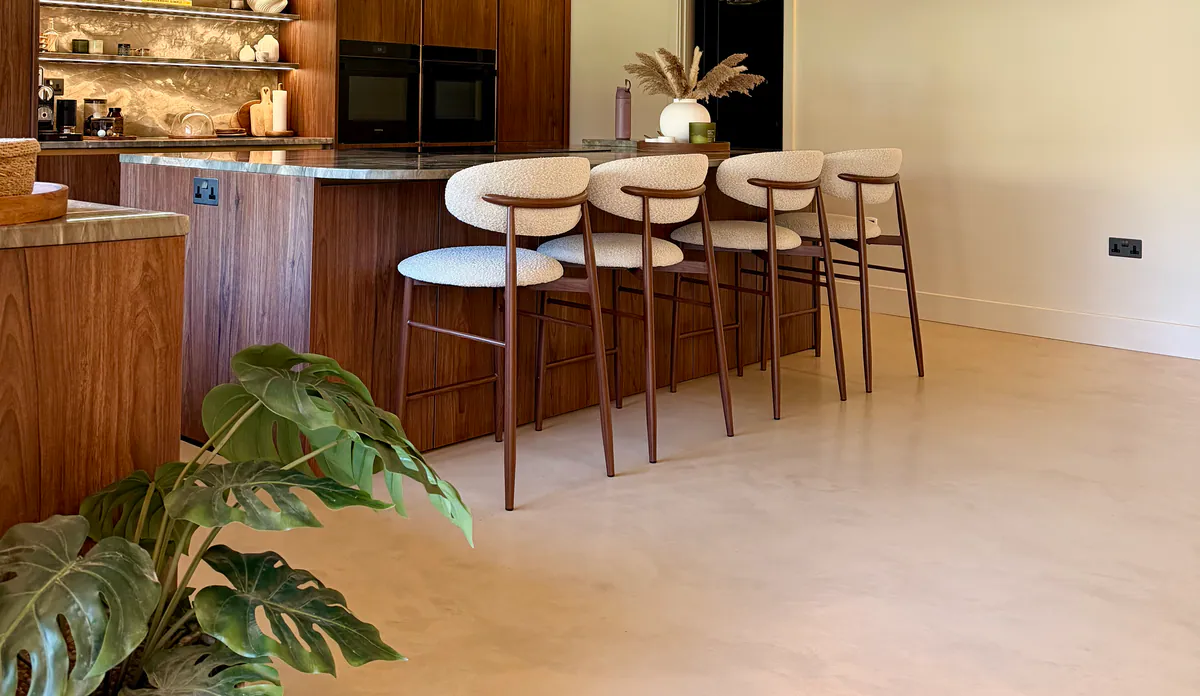
At Atelier di Venice we have completed 150+ projects across London and the South East — Chelsea, Kensington, Mayfair, Belgravia, Notting Hill and beyond — and kitchens are where microcement's seamless quality is most striking. The look is calm and architectural: worktop, island and splashback reading as a single mass of material rather than a kit of parts. Because the finish is only 2-3mm thick, it keeps edges crisp and slim, and it sits comfortably alongside cabinetry in any palette, from pale oak to deep lacquer.
Colour is worked through the application rather than printed in a single layer, so the finish wears gracefully and can be tuned to your scheme — warm greige, soft limestone, smoked clay or near-black — during your free site assessment.
Is microcement heat-resistant enough for a kitchen worktop?
Yes, for normal kitchen use. The cement body itself tolerates everyday warmth — a hot mug, a casserole on a heat mat, splashes from cooking — without scorching or melting the way a laminate worktop can, and it will not burn or give off fumes.
We are, however, honest about the limits, and they sit in the sealer rather than the cement. Like the protective topcoats used on quartz and timber, the sealing layer can be marked by direct, prolonged or extreme heat, so a pan lifted straight off a gas flame or a roasting tray out of the oven should always go onto a trivet or board, never directly onto the worktop. Sudden temperature contrast is what risks fine surface marks or hairline crazing in the seal over time — the same caution good fabricators give even for some natural stones.
The practical takeaway: microcement is a working kitchen surface, not a trivet substitute. Keep a couple of trivets or a heat pad by the hob and you remove the only real heat consideration entirely. This is exactly the kind of guidance we build into the aftercare pack handed over on completion.
Will a microcement worktop stain? How does sealing work?
Sealed microcement is highly stain-resistant — but the sealer is what does the work, so it matters who applies it. Bare microcement is porous; our finished worktops are not, because the final stages of our system close the surface against liquids.
Worktops and splashbacks receive a kitchen-grade, two-stage seal: a penetrating sealer that soaks into the body of the material, followed by a protective topcoat suited to food-contact zones and frequent cleaning. Once cured, common kitchen culprits — red wine, coffee, turmeric, lemon juice, oil, beetroot — wipe away without marking, provided spills are cleaned reasonably promptly rather than left to pool overnight.
Two honest notes. First, strongly acidic substances (neat lemon, vinegar) left sitting can dull an unsealed or under-maintained surface, so wipe them up — the same advice applies to marble. Second, the seal is a wear layer: in a hard-working kitchen we recommend a light maintenance re-seal of worktops and splashbacks every 2-3 years, in line with how we treat all high-traffic and wet areas. It is a quick, low-cost top-up that keeps stain protection at full strength, and we cover the method in your aftercare guidance.
How does microcement compare to quartz, granite and laminate?
Each worktop material has its place. The table below compares microcement with the most common alternatives on the points London clients ask about most — seams, heat, repairability and the ability to refit without ripping out the old top.
| Factor | Microcement | Quartz | Granite | Laminate |
|---|---|---|---|---|
| Seams / joints | None — fully seamless, including worktop-to-splashback | Visible joins on larger runs and corners | Visible joins on larger runs | Joins and edge strips |
| Thickness | 2-3mm coating | 20-30mm slab | 20-30mm slab | Board + laminate |
| Over existing worktop? | Often yes, if substrate is sound | No — full replacement | No — full replacement | No — full replacement |
| Everyday heat | Good — use trivets for hot pans | Good — trivets advised (resin can scorch) | Very good — natural stone | Poor — scorches |
| Stain resistance (sealed) | High | Very high | High | Moderate |
| Repair / refresh | Localised repair and re-seal on site | Difficult — usually replace | Difficult — usually replace | Replace |
| Seamless wraparound look | Yes — worktop, island, splashback as one | Limited | Limited | No |
Microcement's standout advantages are the seamless wraparound aesthetic and the option to finish over an existing top. Granite, as natural stone, is the most heat-tolerant in absolute terms; quartz's polymer resin can discolour under high heat, so trivets are advised there too. Microcement competes on continuity, slim profile and the ability to renovate without a strip-out.
Can microcement go over my existing worktops?
In many cases, yes — and it is one of the main reasons clients choose it. Because microcement is only 2-3mm thick and bonds to a prepared surface, we can often apply it directly over an existing worktop, island or tiled splashback, the same way we apply it over tiles, concrete and screed elsewhere in the home.
The substrate has to be sound: solid, stable, free of movement and structurally fit to take a bonded finish. Our technical assessment — step one of our five-step system — checks exactly this. Worktops in good MDF, chipboard, tile or existing stone are frequently suitable; surfaces that flex, are water-damaged, or are poorly fixed may need remedial work or carcass replacement first, which we identify upfront rather than after starting.
The upside when it works: no rip-out, no skip hire, no kitchen out of action for a fortnight, and minimal disruption to splashback tiling, cabinetry and plumbing. You keep your existing layout and units, and simply change the surface that everyone sees and touches.
Is a seamless splashback more hygienic than tiles?
Yes — and it is a genuine, not cosmetic, advantage. A microcement splashback has no grout lines. Grout is the part of a tiled splashback that absorbs grease, discolours, harbours dirt and eventually needs scrubbing or re-grouting. Remove the joints and you remove the maintenance headache along with the place dirt collects.
A sealed, continuous surface behind the hob and along the worktop wipes clean in seconds with a soft cloth and a pH-neutral cleaner. Cooking grease, sauce splashes and limescale sit on top of the seal rather than soaking into joints, so the splashback stays looking new with very little effort. The same logic applies to the worktop itself: one unbroken plane is faster to clean and far harder for grime to hide in than a worktop-plus-tile arrangement with multiple edges and seams.
For open-plan Chelsea and Kensington kitchens that flow into living space, this matters aesthetically too — a single seamless tone reads quieter and more refined than a grid of tiles, and keeps the whole room feeling considered.
How do I care for a microcement worktop? (Do's and don'ts)
Microcement worktops are low-maintenance, not no-maintenance. The rules are simple and mostly common sense; follow them and the finish stays beautiful for years between professional re-seals.
| Do | Don't |
|---|---|
| Wipe spills reasonably promptly, especially wine, oil and acidic foods | Leave acidic liquids (lemon, vinegar) pooling overnight |
| Clean with a soft cloth and pH-neutral cleaner | Use bleach, ammonia, abrasive pads or scouring powders |
| Use a chopping board for cutting | Cut or chop directly on the surface |
| Use trivets or heat pads for hot pans and trays | Place pans straight from hob or oven onto the worktop |
| Re-seal worktops and splashbacks every 2-3 years | Drag heavy or sharp items across the surface |
| Follow the aftercare pack we provide on handover | Use unknown sealers or DIY products on the finish |
This is essentially how you would already treat a quality timber or marble worktop. The headline difference is what you gain: no grout to bleach, no joints to re-silicone, and a surface that can be locally repaired and refreshed on site rather than replaced.
What does a microcement kitchen worktop cost in London?
Microcement is priced from £185/m², which includes our full five-step installation, all materials and the 2-year written warranty. Worktops and splashbacks cover a smaller area than a full floor, which makes them an accessible, high-impact entry point — many clients start here, then extend the same finish to the kitchen floor, utility or a whole-home scheme once they have lived with it.
Worktop and splashback projects are quoted on measured area, edge detailing and substrate condition rather than slotted into the room ranges we use for floors. As an approximate rule of thumb, the larger share of any microcement project's cost sits in skilled labour and the carefully controlled, multi-day application, with premium materials and sealers making up a smaller proportion — and all of it is captured in the single per-m² figure we quote, with no hidden extras. Intricate edges, full-height splashbacks and waterfall island ends take more hand-work and are reflected in the quote upfront.
Our five-step system underpins every price: (1) technical assessment, (2) surface protection, (3) reinforcement and structural control with joint sealing and fibre mesh, (4) controlled layered application, and (5) final sealing and quality inspection. You can see the full process and finishes on our microcement and services pages, and the most accurate way to get a figure for your kitchen is a free site assessment.
Why choose Atelier di Venice for your kitchen?
Microcement worktops live or die on application quality — the substrate prep, the reinforcement, and above all the sealing in a food and water zone. This is specialist work, not a quick coating job.
- 150+ completed projects across London and the South East, including kitchens in Chelsea, Kensington, Mayfair, Belgravia, Knightsbridge, Notting Hill, Marylebone, Fulham, Battersea, Islington and Hackney.
- Reinforced five-step system with joint sealing and fibre mesh on every install to control cracking — critical on worktops and islands that move and get daily use.
- Kitchen-grade two-stage sealing suited to food contact, cleaning and splashes, with clear aftercare guidance on re-sealing.
- 2-year written warranty included as standard, with transparent, all-in pricing from £185/m².
To discuss a worktop, splashback or full kitchen, book a free site assessment. Call 07541 244064 or email contact@atelierdivenice.co.uk and we will assess your existing surfaces, talk through colour and finish, and provide a detailed written quote.
Frequently Asked Questions
Can you put microcement on kitchen worktops?
Yes. Microcement is applied 2-3mm thick over a sound substrate to create a seamless, sealed worktop, and it can often go directly over an existing top if the carcass is solid and stable. Our technical assessment confirms suitability before any work begins, and every install includes kitchen-grade two-stage sealing and a 2-year written warranty.
Can you put hot pans on a microcement worktop?
Microcement handles everyday kitchen heat — warm dishes, splashes and a casserole on a heat mat — without scorching. However, the sealing layer can be marked by very high heat, so always use a trivet or heat pad for pans straight from the hob or oven, exactly as you would with a marble, quartz or timber worktop. This avoids fine surface marks over time.
Does a microcement splashback stain from cooking grease and sauces?
Once sealed, a microcement splashback is highly resistant to grease, sauce splashes and limescale, and wipes clean with a soft cloth and pH-neutral cleaner. There are no grout lines for grime to soak into. We recommend a light maintenance re-seal every 2-3 years in hard-working kitchens to keep stain protection at full strength.
Can microcement go over my existing kitchen worktops without ripping them out?
Often yes. Because microcement is only 2-3mm thick and bonds to a prepared surface, it can frequently be applied over existing MDF, chipboard, tile or stone worktops and tiled splashbacks, provided they are solid and free of movement. This avoids rip-out, skip hire and a long kitchen shutdown. Our assessment confirms whether your existing surfaces are a suitable substrate.
How much does a microcement kitchen worktop and splashback cost in London?
Microcement starts from £185/m², including the full five-step installation, all materials and the 2-year written warranty. Worktops and splashbacks are quoted on measured area, edge detailing and substrate condition. Because they cover a smaller area than a floor, they are an accessible, high-impact way to start. Book a free site assessment for an exact figure.
Is a microcement worktop more hygienic than tiles or laminate?
Yes. A seamless microcement worktop and splashback have no grout lines or edge strips where grease and dirt collect. The sealed, continuous surface wipes clean quickly and is far easier to keep hygienic than tiled or jointed alternatives, which is one reason microcement suits open-plan London kitchens that flow into living space.
Ready to Get Started?
Contact us for a free site assessment. We respond within 24 hours.
Get a Free Quote