How much does microcement cost per square metre?
Microcement costs from £185 per m². That is a starting rate, not a flat rate: substrate condition, room size, detail and access move a project above it. Smaller rooms work out higher per square metre than large open floors. The scope of a final quote, including access, tanking and any further preparation, is confirmed at survey.
Smaller, more detailed rooms sit towards the upper end of their range per square metre, and large open floors towards the lower end. Indicative totals by room follow below.
What does the price include?
A microcement price covers preparation, materials and skilled labour across the five steps: technical assessment, surface protection, reinforcement and structural control, controlled application and final quality inspection. A 2-year written warranty is provided on microcement installations. This does not affect your statutory rights. Items such as tanking, demolition and access depend on the project and are confirmed at survey.
The steps are described on the microcement in London page.
Why is microcement so expensive?
Most of the cost is skilled labour and preparation, not material. As approximate guidance, materials run at £45-60 per m² and labour and preparation at £125-140 per m², so materials are roughly a quarter to a third of the price. The finish is built in layers over a reinforced substrate, and that work cannot be rushed.
| Cost element | Approximate per m² | Share of price |
|---|---|---|
| Materials | £45-60 | 25-33% |
| Labour and preparation | £125-140 | 67-75% |
The split is approximate guidance, not a fixed quote. It shifts with the substrate, the detail in the room and the finish. Skimping on preparation or reinforcement is how a thin coating fails early, which is why the lifespan guide treats the installation as the deciding factor.
How much does a bathroom, kitchen or apartment cost?
Indicative totals: a wet room of 4-8 m² runs £1,800-£3,500, a bathroom of 8-15 m² £2,000-£4,500, a kitchen floor of 15-25 m² £3,000-£5,500, open-plan living of 30-50 m² £5,500-£10,000 and a full apartment of 60-100 m² £11,000-£20,000. These are estimates for budgeting, confirmed at survey.
| Space | Typical size | Indicative total |
|---|---|---|
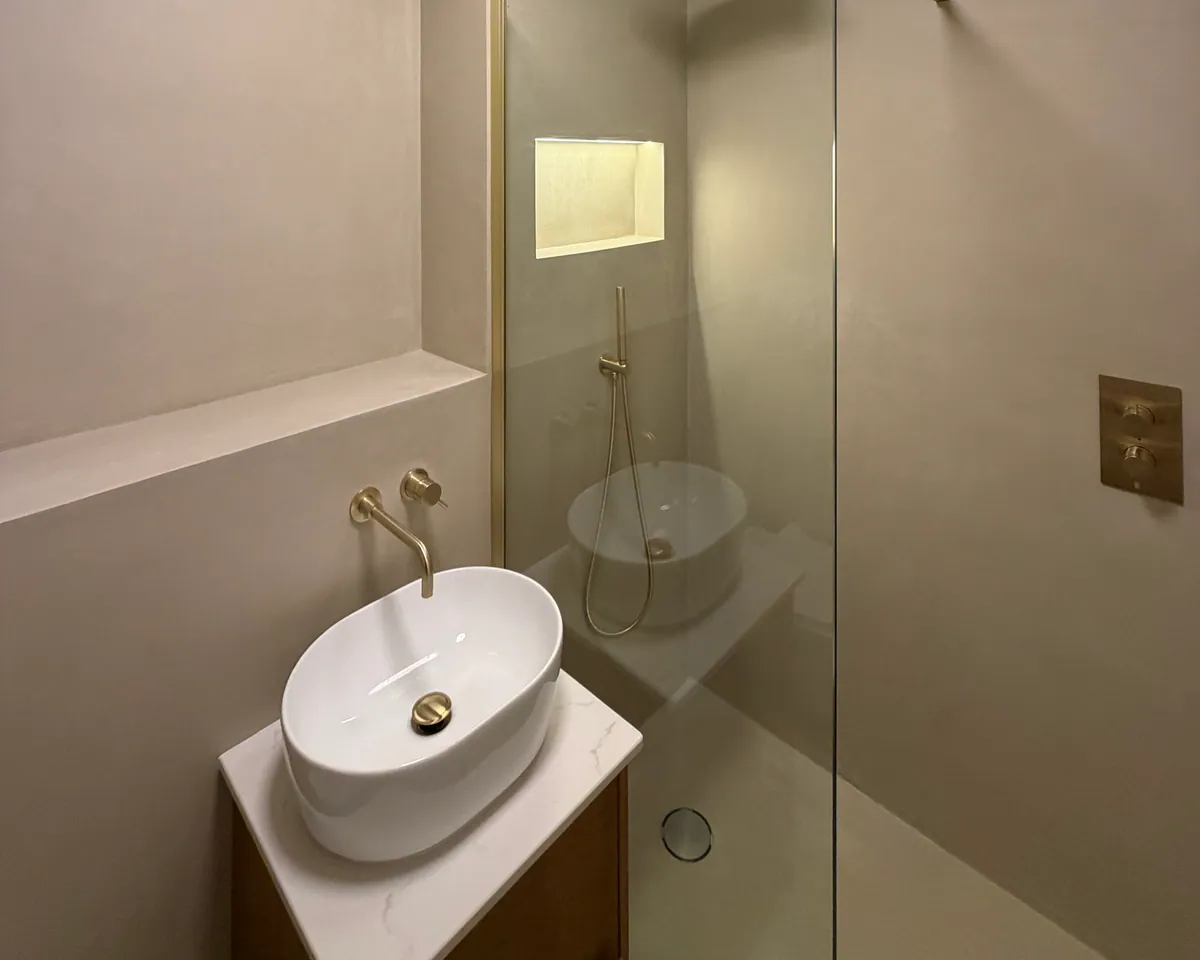
| Wet room or shower | 4-8 m² | £1,800-£3,500 |
| Bathroom | 8-15 m² | £2,000-£4,500 |
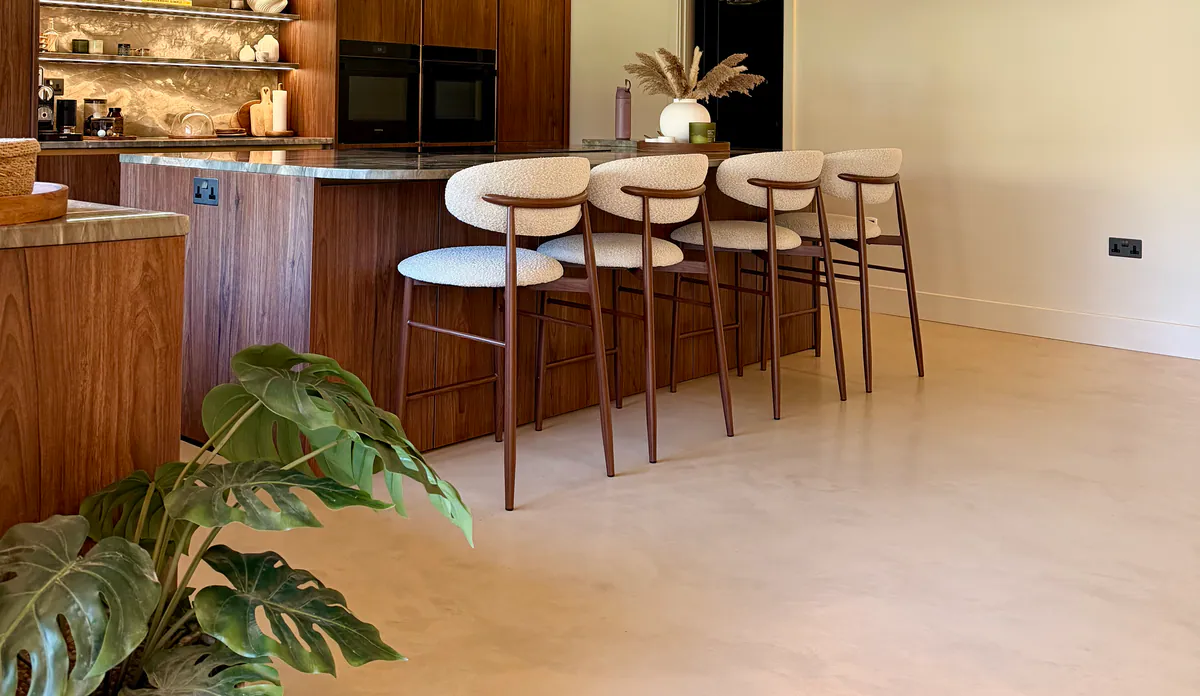
| Kitchen floor | 15-25 m² | £3,000-£5,500 |
| Open-plan living | 30-50 m² | £5,500-£10,000 |
| Full apartment | 60-100 m² | £11,000-£20,000 |
Smaller rooms cost more per square metre than the starting rate, because preparation, set-up and detail do not shrink with the area. Bathrooms and wet rooms are covered on the microcement bathrooms and wet rooms page, and floors on the microcement flooring page.
Four worked examples
These four examples are hypothetical. They are not completed projects, and they carry no location. They show how the ranges above translate into a total.
| Example | Area | Indicative total |
|---|---|---|
| Wet room over existing tiles | About 6 m² | About £2,900 |
| Kitchen floor | About 20 m² | About £4,600 |
| Open-plan living and kitchen | About 42 m² | About £8,200 |
| Apartment floors throughout | About 75 m² | About £15,500 |
A microcement installation typically takes 3-7 working days and a bathroom 4-6 working days. Larger jobs are confirmed at survey.
Is microcement cheaper than tiles?
Not rate for rate, and not always. The two are compared as systems. A tiled surface involves tile, adhesive, grout and, where an existing surface is removed, demolition and disposal. A microcement installation involves preparation, reinforcement, layered application and sealing, and usually avoids removing a sound existing surface, subject to assessment.
| Aspect | Microcement | Tiling |
|---|---|---|
| Grout | None | Grout lines to seal, clean and eventually replace |
| Existing surface | Often retained where sound, subject to assessment | Often removed first |
| What drives the cost | Preparation, reinforcement and skilled labour | Tile, adhesive, grout, removal and disposal |
Where there is no existing surface to retain, such as a new substrate, microcement is not the cheaper route by default. The comparison then rests on the finish itself.
How is a quote built?
A quote is built after a survey. The survey assesses the substrate, the area, the detail in the room, access and the finish, and the figure is confirmed from those findings. Early guidance is possible from the approximate area in square metres, the rooms involved and whether tiles are already in place.
- Substrate condition. A sound, level floor needs less preparation than a cracked or uneven one.
- Area. Larger continuous areas carry a lower rate per square metre, because set-up is spread across more of it.
- Detail. Niches, corners, a shower former and fixtures take more hand-finishing than a simple floor.
- Access. A high-floor flat with restricted access and lift bookings takes more time than a ground-floor space.
Start an enquiry with the approximate area and the rooms involved.
Frequently asked questions
How much does microcement cost per m² in London?
From £185 per m². Smaller rooms cost more per square metre, and a final price follows a survey. The scope of a quote, including access, tanking and any further preparation, is confirmed at survey.
Why is microcement so expensive?
Most of the cost is skilled labour and preparation: approximately £125-140 per m² for labour and preparation against £45-60 per m² for materials. The finish is built in layers over a reinforced substrate, and that work cannot be rushed.
How much does a microcement bathroom cost?
A bathroom of 8-15 m² is estimated at £2,000-£4,500 and a wet room of 4-8 m² at £1,800-£3,500. These are indicative totals, confirmed at survey.
Is microcement cheaper than tiling?
Not rate for rate, and not always. A tiled surface involves tile, adhesive, grout and often removal of the existing surface. Microcement usually avoids removing a sound existing surface, subject to assessment. On a new substrate with nothing to remove, it is not the cheaper route by default.
Do you need to remove existing tiles before microcement?
In many cases, no, where the tiles are sound and well bonded. The technical assessment, the first of the five steps, decides.
How long does a microcement installation take?
A microcement installation typically takes 3-7 working days and a bathroom 4-6 working days. Larger jobs are confirmed at survey.
Start a project
Enquire about your project
Tell us about the space and the finish. We review the details and reply with the next step.